Digital or analogue pressure gauges - how to choose gauges for air conditioning service
Pressure gauges are an essential tool for evacuation, charging and diagnosing refrigeration systems. Whether you choose digital or analogue depends on the refrigerants you work with, the type of jobs you do and whether you need a manifold with two gauges or a single gauge for quick checks.

- Digital gauges support many refrigerants and display saturation temperatures, while analogue gauges have scales for selected refrigerants.
- A two-gauge manifold is used for full diagnostics, a single gauge for quick checks on one side of the system.
- When choosing, check the pressure range, the list of refrigerants, the connections and the power supply.
What pressure gauges are used for in air conditioning service
Pressure gauges let you read the pressure on the low (suction) side and the high (discharge) side of the system, and manifolds with valves also let you control refrigerant flow during evacuation and charging. Based on the pressure and the corresponding saturation temperature, the service engineer assesses system operation, the refrigerant charge and the tightness of the installation.
Digital pressure gauges
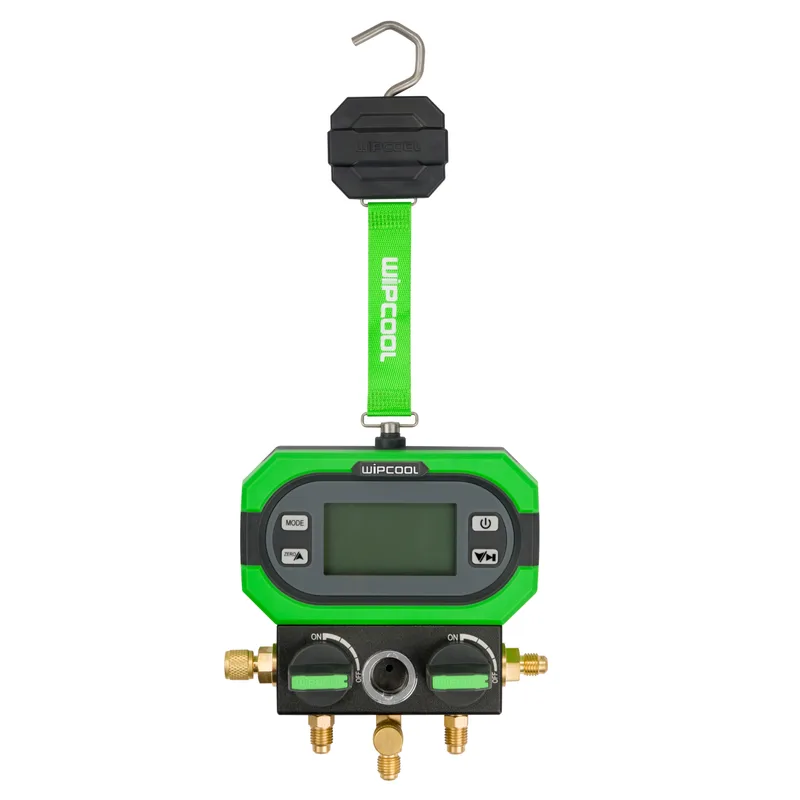
A digital pressure gauge shows the pressure on a display and instantly converts it to the saturation temperature for the selected refrigerant. There is no need to use tables or scales printed on the dial, and one instrument supports many refrigerants. The Wipcool MDG-2K Digital Manifold measures pressure on both sides of the system from -1 to 55 bar and has 45 refrigerants stored in memory, including R32, R134a, R290, R404A, R407C, R410A, R452B, R454B, R513A, R1234yf and R744. It displays evaporating and condensing temperatures, has PT, HOLD and VAC modes, and is powered by 2 AAA batteries (200 h operating time with the display backlight off).
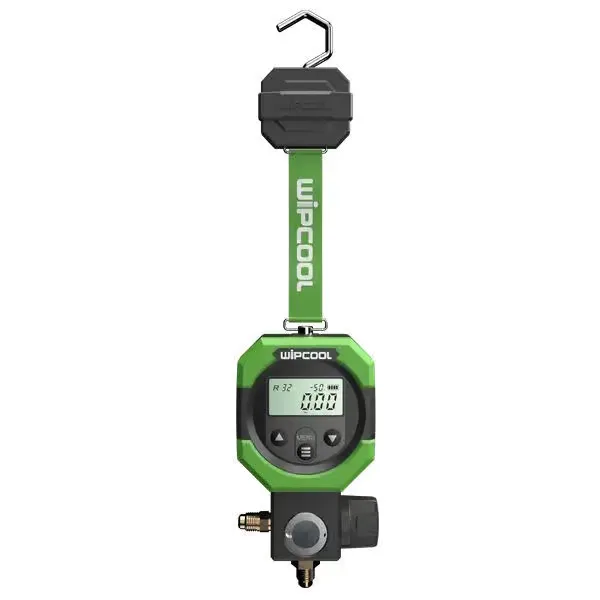
For quick measurements on one side of the system, use the single Wipcool MDG-1 Digital Pressure Gauge. It has a control valve, a range of 0–55 bar (vacuum from -1 to 0 bar), an overload pressure of 75 bar and an accuracy of ±0.2 bar at 22 °C. It supports 16 refrigerants, displays the evaporating temperature and has a built-in Li-ion battery charged via a USB Type-C port.
Analogue pressure gauges
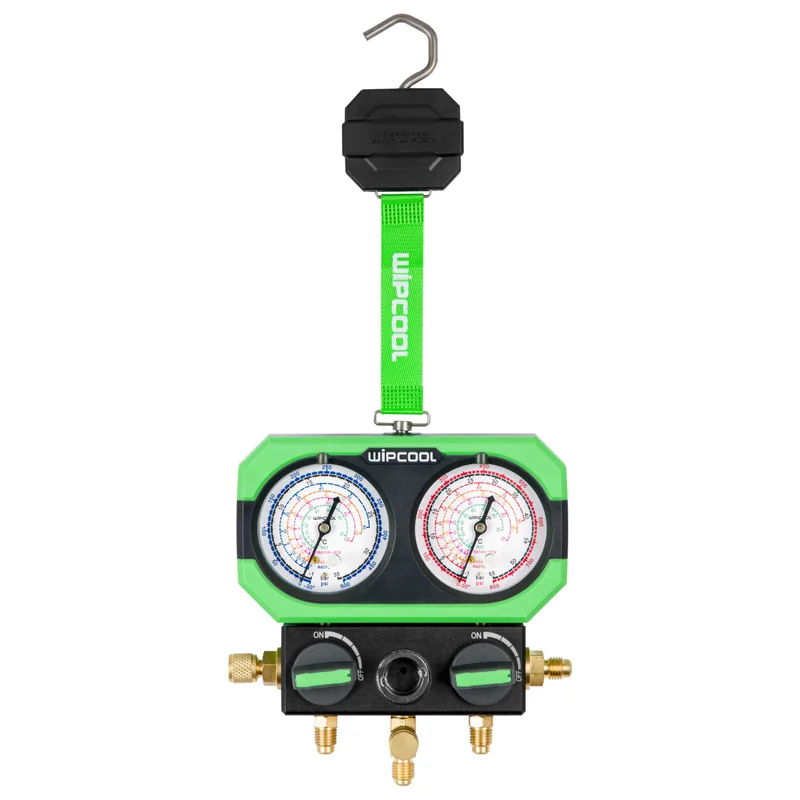
Analogue gauges are read from a needle on a dial printed with temperature scales for specific refrigerants. The analogue Wipcool MG68-2K and Wipcool MG68-2KE manifold gauge sets are used for pressure measurement, evacuation and charging of systems with R32, R410A, R404A and R407C. The low-side gauge has a range of -1 to 34.5 bar, the high-side gauge -1 to 55.2 bar, and the dials are Ø60. Both sets have ball valves, a sight glass and a shock-resistant housing. They differ in their accessories: the MG68-2K comes with 3 × 1.5 m charging hoses, 2 × 5/16"–1/4" adapters and a bag, while the MG68-2KE comes with 3 × 1.2 m charging hoses and a case.
Single low-side and high-side gauges
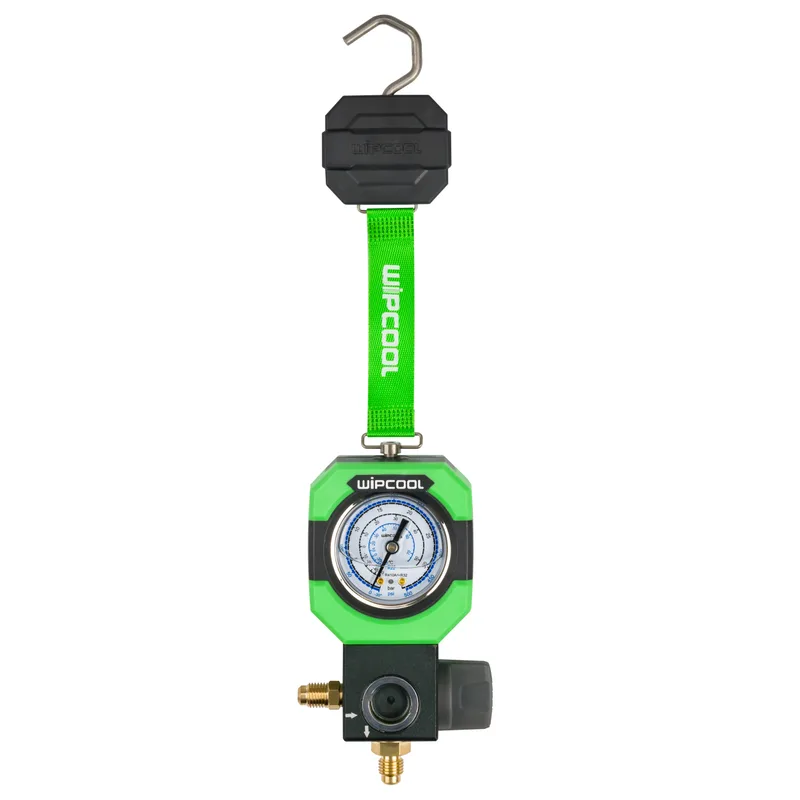
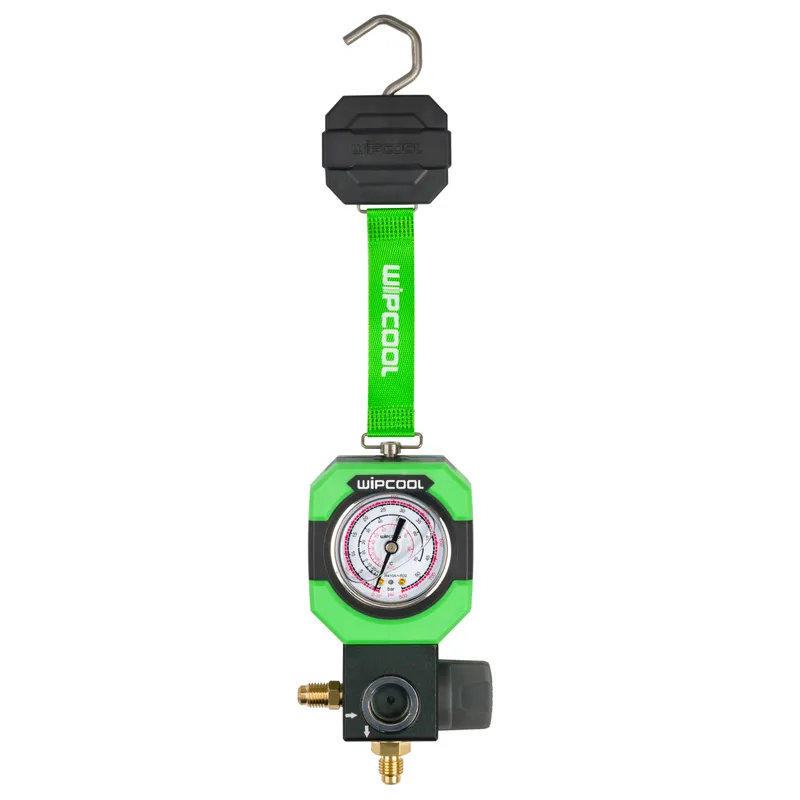
When you only need a reading from one side of the system, a single gauge with a valve does the job. The Wipcool MG-1L Low-Side Gauge has a range of -1 to 34 bar, and the Wipcool MG-1H High-Side Gauge -1 to 55 bar. Both have scales for R410A and R32, a Ø50 dial, are oil-filled and shock-resistant. The LED dial illumination is powered by a built-in battery charged via a Type-C port, which makes reading easier in poorly lit locations.
| Product | Type | Pressure range | Refrigerants | Connections |
|---|---|---|---|---|
| MDG-2K (manifold) | Digital | -1 to 55 bar | 45 refrigerants | 3 × 1/4" SAE |
| MDG-1 (single) | Digital | 0–55 bar | 16 refrigerants | 2 × 1/4" SAE |
| MG68-2K (manifold) | Analogue | -1 to 34.5 bar / -1 to 55.2 bar | R32, R410A, R404A, R407C | 3 × 1/4" SAE |
| MG68-2KE (manifold) | Analogue | -1 to 34.5 bar / -1 to 55.2 bar | R32, R410A, R404A, R407C | 3 × 1/4" SAE |
| MG-1L (single, low side) | Analogue | -1 to 34 bar | R410A, R32 | 2 × 1/4" SAE |
| MG-1H (single, high side) | Analogue | -1 to 55 bar | R410A, R32 | 2 × 1/4" SAE |