
 Distribution PL · 4REF
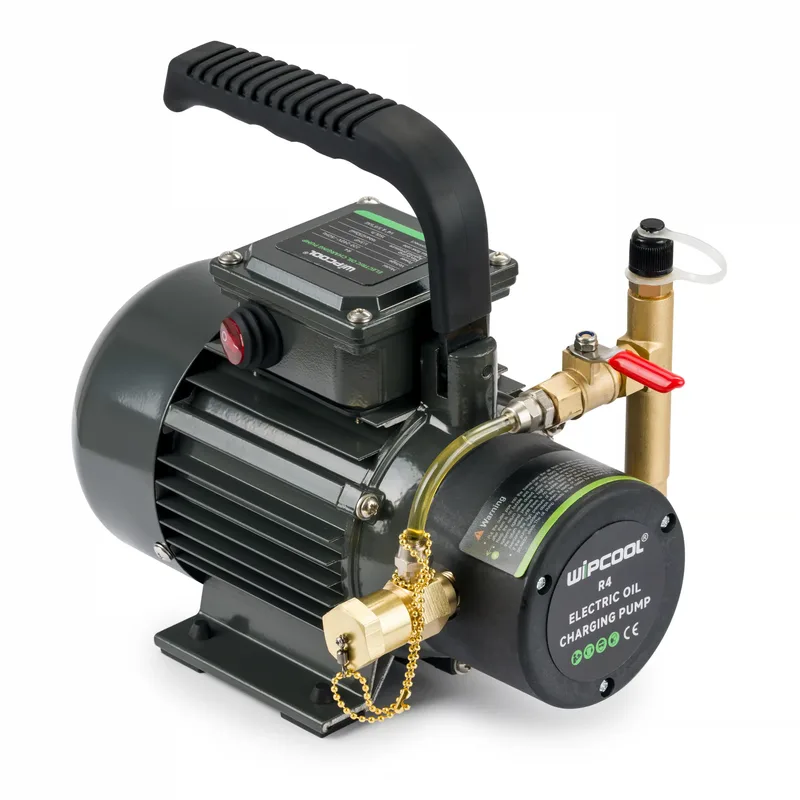
Wipcool R4/R6 user manual
The Wipcool R4 and R6 electric oil charging pumps are designed to top up or replace oil in compressors. They have an integrated gear pump. Both models also pump high-viscosity oils at low temperatures.
The user manual is an integral part of the product. Please read this manual carefully and follow all instructions closely.
General information
Wipcool products are designed for professional use by qualified air conditioning and refrigeration engineers. As the manufacturer, Wipcool specifies that our equipment should only be operated by suitably qualified and trained persons.
- ■Observe all local safety regulations and general safety standards when using the Wipcool R4/R6 oil charging pump.
- ■The user manual should be kept near the device so that personnel can access it easily at any time.
- ■Before use, qualified personnel should read the user manual carefully and understand all the instructions it contains.
- ■The manufacturer accepts no liability for any damage resulting from improper use, failure to follow the user manual, insufficiently qualified personnel or any unauthorised modifications to the device.
- ■The general terms of sale contained in the sales documents apply.
Symbols and conventions
Signs and markings used on the device and in the manual:
- 01
 Warning - read the text in the box next to the symbol.
- 02
 Dangerous voltage - risk of electric shock.
- 03
 Hot surface - wait for it to cool before touching.
- 04
 Flammable material - risk of fire.
- 05
 Before starting work, read all safety and installation instructions carefully.
- 06
 Indicates that the product meets the health, safety and environmental standards applicable in the European Union.
- 07RoHSThe product meets the requirements for the restriction of hazardous substances.
- 08
 Do not dispose of the pump with household waste.
Safety information
Work in a well-lit area.
Technical specifications
| Parameter | R4 | R6 |
|---|---|---|
| Power supply | 230 V~ / 50 Hz | 230 V~ / 50 Hz |
| Oil type | All types of refrigeration oil | All types of refrigeration oil |
| Motor power | approx. 250 W | approx. 550 W |
| Maximum flow rate | 150 l/h | 350 l/h |
| Maximum back pressure | 16 bar | 25 bar |
| Connections | 1/4" and 3/8" SAE | 1/4" and 3/8" SAE |
| Device dimensions (L × W × H) | 230 × 144 × 216 mm | 308 × 175 × 263.5 mm |
| Device weight | 5.8 kg | 11.0 kg |
Device diagram
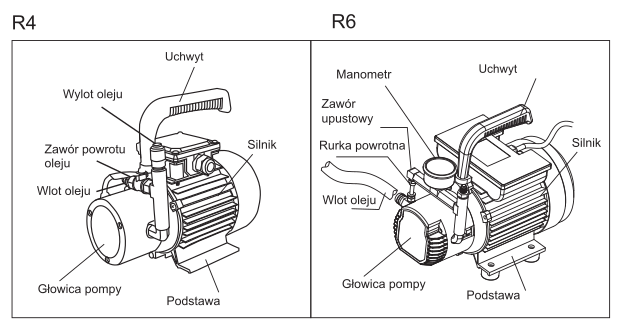
The R4 has an oil return valve. The R6 has a pressure gauge, a relief valve and a return tube. The motors of both pumps have a cooling fan and thermal protection.
Use the power switch to switch the pump on and off.
Package contents
After unpacking, check that the package is complete and in good condition. Report any missing or damaged items to the seller.
| Item | R4 | R6 |
|---|---|---|
| Pump | R4 | R6 |
| Suction hose | 0.8 m | 0.8 m |
| Discharge hose | 1.5 m | 1.5 m |
| Adapters | 1/4" and 3/8" SAE | 1/4" and 3/8" SAE |
| Case | Included | Included |
| User manual | Included | Included |
The R6 package also includes a hose clamp.
Transport and storage
- ■Transport the device in its original packaging.
- ■Store the pump in a dry place at a temperature of -20–+60 °C, away from direct sunlight and heat sources.
Connection
- 01Check that the supply voltage matches the voltage specified on the pump's rating plate.
- 02Clean the suction hose and discharge hose to prevent contamination of the oil. With the pump switched off, connect both hoses to its connections.
- 03Place the free end of the suction hose in the oil container. Do not connect the discharge hose to the compressor yet. Connect the pump to the power supply.
Operation
Bleeding air and charging oil
- 01Direct the free end of the discharge hose into the oil container and switch on the pump so that it draws in oil and removes air from the suction hose and pump body.
- 02Observe the oil flow. When there is no foam or visible air bubbles in the oil and no distinct sound of escaping air can be heard, switch off the pump.
- 03Connect the free end of the discharge hose to the closed oil charging service valve on the compressor.
- 04Switch on the pump, then open the service valve to start pumping oil.
- 05After pumping in the oil, close the service valve, then switch off the pump.
- 06Disconnect the discharge hose from the service valve.
During operation - R4
If the pressure in the pump is too high and the motor is running too slowly, open the oil return valve. Once the speed has stabilised, close the valve.
During operation - R6
Read the discharge pressure on the pressure gauge. When it exceeds 25 bar, the relief valve opens. Oil returns through the return tube to the oil inlet, reducing the pressure in the discharge hose.
Maintenance
Use clean refrigeration oil. Check its condition before use, especially after prolonged storage.
After disconnecting the pump and hoses, wipe any remaining oil from the hoses and pump, then pack them in a sealed plastic bag.
Troubleshooting
| Problem | Possible cause | Solution |
|---|---|---|
| Pump does not start | No power supply | Check the power supply and power switch. |
| Pump does not start | Incorrect voltage | Check that the input voltage is within ±5% of the rated voltage. |
| Pump does not start | Ambient temperature too low | Move the pump to a warmer location. |
| Pump does not start | Pump blocked by dirt | Have the pump repaired by the service department - submit a service request at wipcool.pl/serwis. |
| Flow rate is too low or the pump does not pump oil | Blocked suction hose | Clean the suction hose. |
| Flow rate is too low or the pump does not pump oil | Air in the pump or suction hose | Bleed air from the pump and suction hose (see ‘Bleeding air and charging oil’, steps 1–2). |
| Flow rate is too low or the pump does not pump oil | Blocked discharge hose | Clear the discharge hose. |
| Flow rate is too low or the pump does not pump oil | Oil level too low | Check the oil level and make sure the end of the suction hose is submerged below the oil surface. |
| Flow rate is too low or the pump does not pump oil | Pump has been stored for a long time | Pour a small amount of oil into the oil inlet. |
| Pump is excessively noisy | Oil level too low | Check the oil level and make sure the end of the suction hose is submerged below the oil surface. |
| Pump is excessively noisy | Contamination inside the pump | Have the pump repaired by the service department - submit a service request at wipcool.pl/serwis. |
| Pump is excessively noisy | Air in the pump or suction hose | Bleed air from the pump and suction hose (see ‘Bleeding air and charging oil’, steps 1–2). |
| Pump is excessively noisy | Damaged internal pump parts | Have the pump repaired by the service department - submit a service request at wipcool.pl/serwis. |
| Pump temperature is too high | Operating pressure exceeds the pump's maximum back pressure | Select a pump model suited to the operating pressure. The maximum back pressure is: R4 - 16 bar, R6 - 25 bar. |
| Pump temperature is too high | Insufficient motor cooling | Check that the motor fan is working. |
| Pump temperature is too high | Ambient temperature too high | Move the pump to a cooler location. |
| Pump temperature is too high | Insufficient ventilation | Place the pump in a location with better airflow. |
Waste electrical and electronic equipment
- 01The crossed-out bin symbol means that the used device must not be disposed of with other waste.
Under the applicable regulations on waste electrical and electronic equipment, products marked with the separate collection symbol must not be disposed of with other municipal waste. Because they contain hazardous substances, electronic products that are not collected separately can be dangerous to the environment and human health. Proper separate collection of waste electrical and electronic equipment prevents negative impacts on the environment.
By taking used equipment to a collection point, the user contributes to its reuse, recycling and recovery.
Recycling - a method of protecting the environment. The process of recovering substances from waste that can be reused as raw materials.
Waste recovery - the use of waste that has lost its useful value, such as plastics, paper and cardboard, as secondary raw materials. In common usage, the term also includes destruction.
Information about the collection system for waste electrical and electronic equipment
- ■Waste electrical and electronic equipment must not be disposed of with other waste.
- ■Collecting incomplete electrical and electronic equipment and parts from waste equipment is prohibited.
- ■A distributor delivering equipment intended for households to a purchaser must collect waste household equipment free of charge at the place of delivery, provided that the waste equipment is of the same type and performs the same function as the equipment delivered.
- ■The user may hand over waste equipment to a waste equipment collector, a treatment facility or a municipal waste collector in the municipality.
- ■Information about collection points is available on the public information bulletin (BIP) websites of regional, city and municipal offices.
Service and documents
Before submitting a service request, prepare:
- ■Model - shown on the device's rating plate and on the invoice.
- ■Serial number - if there is none, provide the production number (e.g. 11/2025), usually found on the underside of the device.
- ■Proof of purchase - an invoice or receipt from an authorised distributor.
- ■Description of the fault - what is happening, when it started and under what conditions.
Submit a service request at wipcool.pl/serwis. You can also find the warranty terms there.